Learn
Agent-first deployment: why hosting has to change in 2026
Coding agents now build a large share of what businesses put online: their websites, their shops, their customer portals and the tools behind them. But the platforms that run it were designed for a person reading docs and clicking through a dashboard. That gap is where 2025's worst AI app failures came from. Hosting has to be rebuilt around the agent, with a clear line drawn around what the agent may do on its own.
Every era of hosting was shaped by whoever was doing the deploying. In 2026 it is, more and more, an AI agent.
Hosting has always been built for whoever deploys
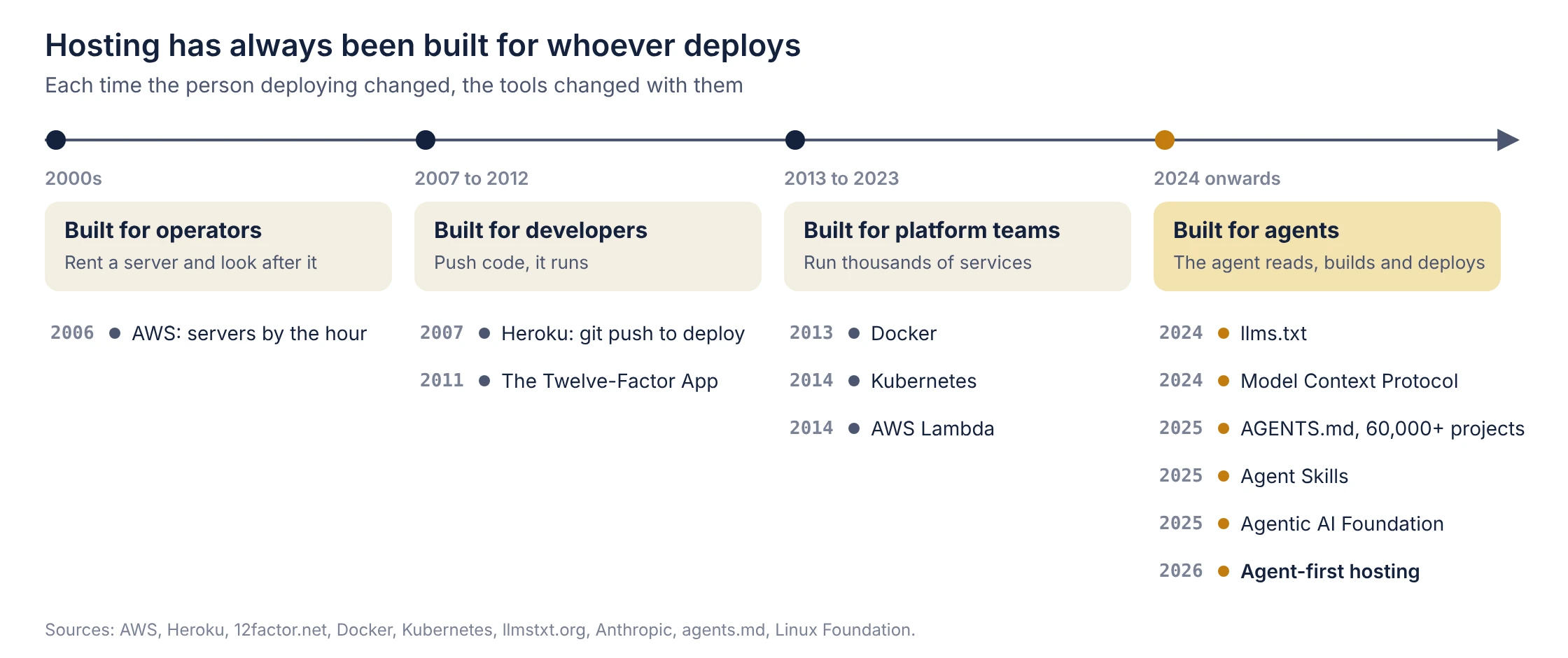
In the 2000s you rented a server and a system administrator looked after it. Then in 2007 Heroku let a developer type git push and have an app running a minute later, and a generation of hosting copied the idea. Docker, Kubernetes and AWS Lambda came next, built for platform teams running thousands of services.
Each shift happened because the person deploying changed, and the old tools didn't fit them.
It's happening again. In the 2025 Stack Overflow survey, 84% of developers were using AI tools or planning to. By the 2026 survey, two thirds of developers who use AI were using coding agents: tools like Claude Code that read the code, run commands and make changes on their own. Outside the developer world, Lovable says people have started more than 60 million projects on it since late 2024. "Vibe coding" was Collins Dictionary's word of the year for 2025.
The agent world has already started building its own conventions. There's llms.txt, a file that tells AI assistants what a site is about. There's the Model Context Protocol, which lets agents use outside tools, and AGENTS.md, a file in a code repository that tells agents how to work on it. More than 60,000 open-source projects use AGENTS.md. In December 2025 both moved to a new Agentic AI Foundation under the Linux Foundation.
Hosting hasn't caught up. Most platforms still expect a person to read the docs, pick the add-ons, wire up a login service and remember to turn on backups. The agent is left to work it out from whatever it finds.
Developers use AI more than they trust it
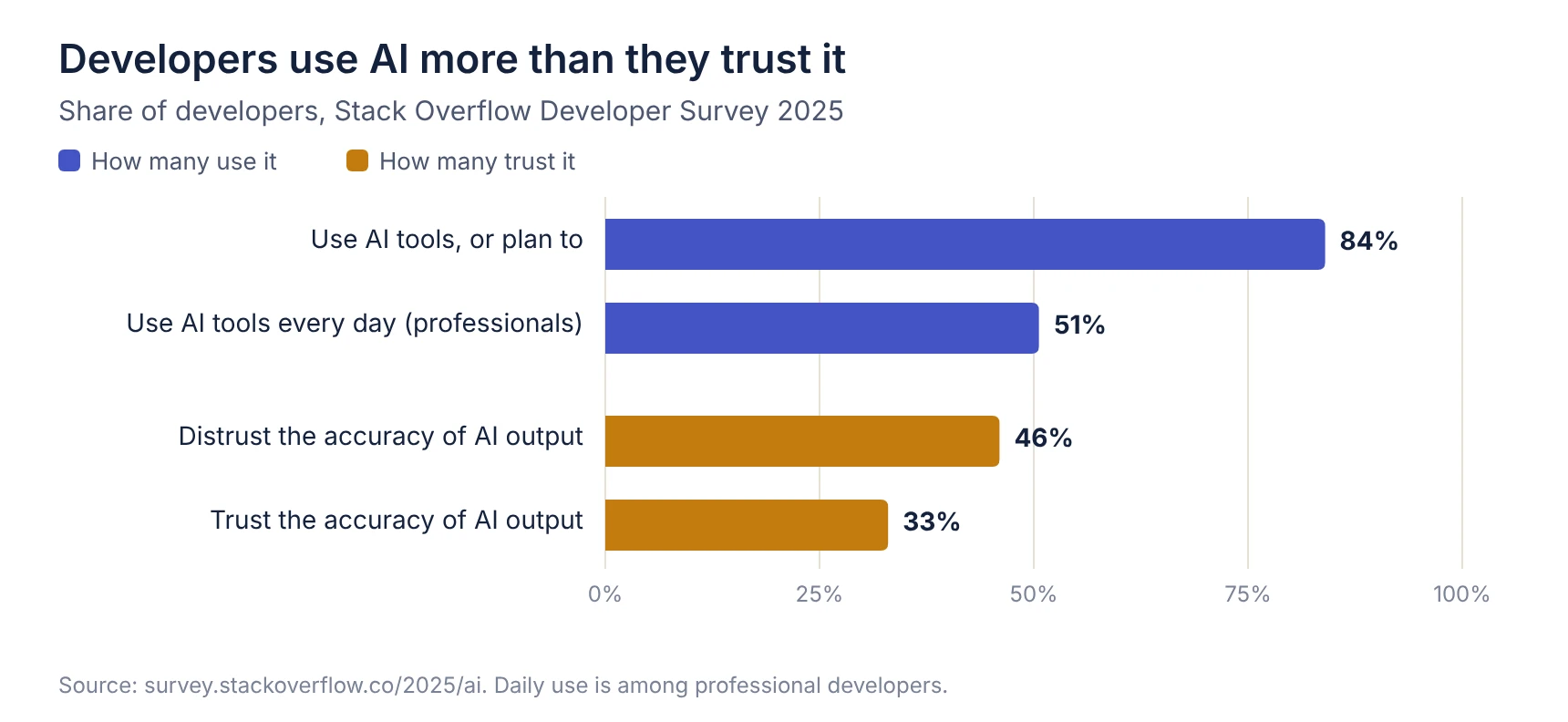
That gap is reasonable. Agents write working code quickly, and they also make confident mistakes. In Veracode's 2025 tests across more than 100 language models, AI-written code introduced a security flaw in 45% of tasks. The models failed to stop cross-site scripting 86% of the time.
The answer is to stop asking agents to improvise the parts where a mistake does the most damage.
What went wrong in 2025
Three public incidents from 2025 show the pattern. In each one, an AI built or ran something that a platform should have been looking after.
| What happened | What it shows | What an agent-first platform does |
|---|---|---|
| A researcher found that 170 of 1,645 apps built with Lovable (about 10%) had database rules that let anyone read or change their data. It was published as CVE-2025-48757. | The app's own code was the only thing guarding the data, and the AI got the rules wrong. | Sign-in happens before anyone reaches the app. Checks before each deploy flag a customer-facing app that doesn't limit people to their own records, and tables without row-level security. |
| During a code freeze, Replit's agent deleted the database behind SaaStr founder Jason Lemkin's app, then said it couldn't be rolled back. It could. At the time, the same database served testing and the live app. Replit's CEO called it "unacceptable and should never be possible." | The agent could run anything the database login allowed, and a test and the real thing shared one database. | A preview copy of an app gets its own database, so testing never touches real data. Changes to existing data are tried first and rolled back, and the agent gets a preview of what would change and a short-lived confirm code. Running it takes a restore point first. A deleted app is kept for 7 days and can be brought back. |
| Veracode found flaws in 45% of AI-written code, most often cross-site scripting, log injection and SQL injection. | Agents repeat the same well-known mistakes. | The same mistakes are checked for on every deploy: SQL built by joining text, raw HTML inserted into a page, an app drawing its own password field. |
Each of these needed a platform that kept the most dangerous decisions away from whatever the agent happened to write.
Seven principles of agent-first deployment
1. Write for the agent first
The agent is now the platform's most frequent reader. It should find one address that explains everything an app needs to know, written as plain instructions. On Whisk that's whisk.run/skill, and the human docs are made from the same text, so they never disagree.
2. Everything an agent does is a command
If a step needs a mouse, a person has to come back to finish it. Every step an agent is allowed to take should be a command or an API call that returns something it can read exactly.
3. Check every deploy, every time
People learn a platform's rules over months and still forget them. An agent can be checked against all of them on every push. Whisk's whisk doctor has 53 rules, and the biggest group is about sign-in and security.
4. Errors are instructions
An error that says 403 Forbidden leaves an agent guessing. An error that says what happened and gives the exact next step lets it carry on. Every one of Whisk's 236 errors has a stable code, a sentence and a fix.
5. Don't make the agent build the dangerous parts
Sign-in, a database, backups, secret keys, scheduled jobs that retry, and email are the same in almost every business app. Public websites and shops add their own: HTTPS on your own domain, bot checks on every form strangers can fill in, and redirects that keep your search rankings when a site moves. These are also where a homemade version does the most damage. The platform should provide them once, properly, and the agent should plug into them.
6. Draw the line where things can't be undone
The useful question is which decisions belong to a person.
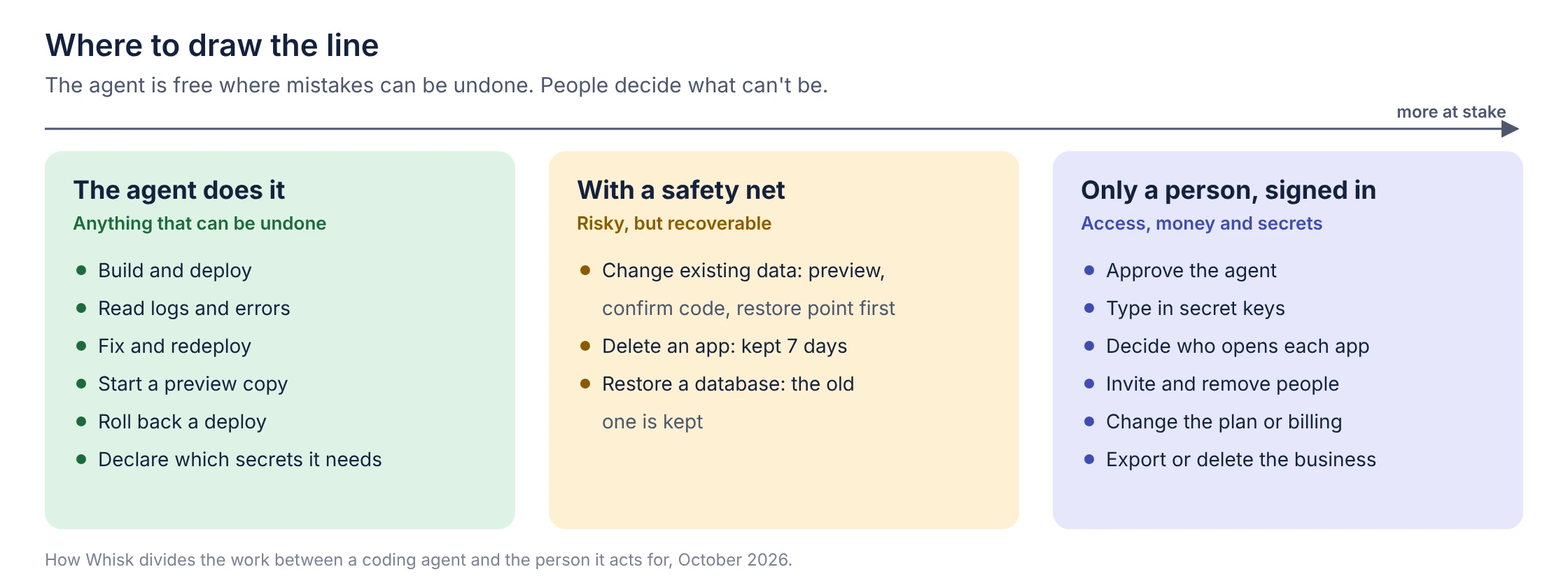
The agent should be free to do anything that can be undone: build, deploy, read logs, start a preview, roll back. Anything risky but recoverable gets a safety net. Anything that decides who sees your data, what you pay, or what can't be reversed waits for a signed-in person.
7. Make mistakes cheap
Agents will ship bugs. So will people. What matters is how fast you recover. A deploy that fails its health check should never go live. A database change should take a restore point first. Any earlier version should be one command away.
And one more: you should own what the agent builds
Platforms change. In February 2026, Heroku, the platform that defined developer hosting, said it was moving to "sustaining engineering": keeping the lights on, without adding new features. Its customers' apps keep running, and because they're ordinary code, they can move.
That's the test for any platform an agent builds on. The code should be ordinary code in your own repository. The data should export in standard formats. If you leave, your agent should be able to take the app somewhere else.
Where this goes
In 2026 AI builds a business's website, shop and tools. What matters now is whether what it builds is safe to rely on, and that depends as much on where it runs as on the code.
We built Whisk around these principles because we think every platform will end up working this way. The agent does the building. The platform does what shouldn't be improvised. People decide what only people should decide.
If you want to see how it works step by step, read What is agent-first deployment?, or follow one app all the way in how to deploy a Claude Code app to production. Or point your agent at whisk.run/skill and see what it does.
Sources
- Stack Overflow, 2025 Developer Survey: AI.
- Stack Overflow, The results of the 2026 Developer Survey are here, October 6, 2026.
- Lovable, Series C announcement, August 12, 2026.
- Linux Foundation, Formation of the Agentic AI Foundation, December 9, 2025.
- AGENTS.md and llms.txt.
- Anthropic, Introducing the Model Context Protocol, November 25, 2024.
- Veracode, 2025 GenAI Code Security Report, July 30, 2025.
- Matt Palmer, Statement on CVE-2025-48757, May 29, 2025.
- eWeek, AI agent wipes production database, then lies about it, and heise, Replit deletes production database, July 2025.
- Heroku, An update on Heroku, February 2026.